Home > News > How to Choose the Right Seafood Grading Machine

How to Choose the Right Seafood Grading Machine?

In seafood processing, size grading is one of the most essential steps.

Larger seafood always sells for a higher price. Mixing a few big pieces into small grades once in a while is not a big issue. But if this happens frequently, factories will face serious economic losses over time.

Even as automated processing becomes more popular, many factory owners still trust manual sorting more. They think manual work delivers almost 100% accurate results. However, labor costs keep rising. Plant owners and project managers need to balance long-term labor expenses and one-time machine investment.
That is why seafood processors need a reliable and suitable sorting solution.

With ten years of experience in the seafood machinery industry, I wrote this practical guide to help you choose the right seafood grading machine.

This article does not cover soft seafood such as octopus, cuttlefish and squid. They are sticky and easily deformed, so standard mechanical graders cannot sort them properly.

What Kinds of Seafood Needs Grading?

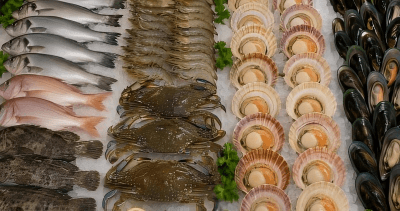
Most popular seafood products require grading during processing. Standard grading helps ensure consistent quality and boost sales prices. Seafood need to be graded mainly falls into three kinds.

Fish

There are many types of fish in various shapes and sizes. This includes long fish like hairtail, flat fish such as pomfret and flounder, and thick-bodied fish like grouper. Small schooling fish such as sardines are also graded in large batches. Different fish types call for different grading machines.

Crustaceans

Crustaceans are the most common products for grading, including all sizes of shrimp, lobsters and crabs. They have hard, regular shells and non-sticky surfaces, making them perfect for precise mechanical sorting.

Shellfish

Shellfish like scallops and mussels also need grading. Their price largely depends on uniform sizes. Standard sizes greatly improve their appearance. Mechanical grading is a must for mass production.

All the seafood above come in different shapes and sizes. Is there a one-size-fits-all solution for all of them?

Unfortunately, no single system can sort every type perfectly for now. But we can select or customize the best setup to meet your needs.

Let’s first take a look at common seafood grading machines on the market, so you can get a clear idea of mainstream sorting solutions.

Four Common Types of Seafood Grading Machines

These four models are the most widely used core sorting machines for seafood grading. I’ll explain how they work, their applications, pros and cons, so you can quickly tell if they fit your products.

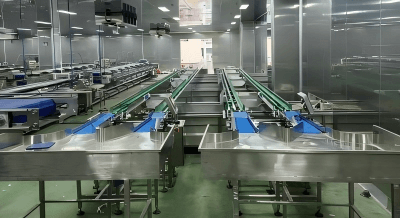
Single/Dual Channel Weight Sorting Machine

Working principle: Dynamic weighing and automatic grading. Each item passes through a separate weighing channel. Sensors measure its weight instantly, the system assigns a grade, and pushers or air blowers divert it to the right bin.

Application: Medium to large fish, extra-large shrimp, bundled crabs and long hairtail. Channel and outlet widths can be customized.

Advantages: Fully digital system with clear data reports and flexible grade settings. Works well for oddly shaped products.

Disadvantages: Relatively high unit price. Operating speed is limited by the weighing process. Multiple units need to be connected for extremely high output.

Key points: Match machine parameters to your product specs. Optimize the frame and pushing/air-blowing force to balance efficiency and product integrity.
Rotating Trays Weight Grader

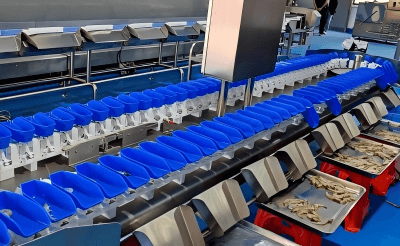
Working principle: Independent weighing trays are mounted on a rotating ring. Products land on trays one by one for dynamic weighing. Trays flip over automatically at designated positions to drop products into collection areas.

Application: Small and medium-sized fish, large shrimp. Also suitable for lobsters and shellfish, depending on feeding speed.

Advantages: Roughly 30% faster than channel-type sorters. Compact design, high output per dollar invested, and the lowest price among the four models.

Disadvantages: Requires accurate and steady manual feeding. Trays need frequent cleaning to avoid stickiness and residue buildup.

Key points: Make sure tray size fits your products and improve edge design to prevent jams. Plan feeding methods, flip angles and buffer zones to cut down product damage.
Common Roller Grading Machine

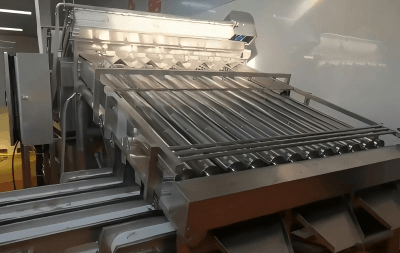
Working principle: Gaps between parallel rollers gradually widen from front to back. Products roll along, and smaller items fall through the gaps step by step to finish size grading.

Application: Ideal for regular fish and shrimp, especially small and medium-sized fish and standard-size shrimp. Supports fully automatic feeding with large output and low maintenance needs.

Advantages: Simple, sturdy structure and easy to clean. Can connect with upstream feeding systems for full automation.

Disadvantages:

Not ideal for ultra-small seafood like sardines running at maximum capacity.

Not suitable for large fish, irregular lobsters and shellfish.

Weight graders are recommended instead for large shrimp.

It is purely mechanical and has no digital data recording function.

Key points: Rollers need to be rust-proof and anti-slip. Keep gaps even and install anti-jam parts to protect seafood.
Composite Layer Roller Grader

Working principle: Custom-built for high-volume processing of small seafood. It adopts a multi-layer design. Each layer has separate gaps, drive systems and running speeds to deliver both high output and accurate grading.

Application: High-density feeding of small seafood such as sardines, and high-speed sorting for fish of uniform size.

Advantages: Delivers the highest output per floor area for small seafood at high speeds. Grading ranges on each layer can be finely adjusted.

Disadvantages: High manufacturing cost, plus a large footprint and overall height. Each layer requires custom rollers, individual motors and frequency converters, making multi-layer synchronization quite complex.

Key points: Check workshop ceiling height and floor load capacity, and ensure enough space for maintenance. Control product dropping between layers to avoid cross mixing. Use two sets of sorting units if you need many grading levels.
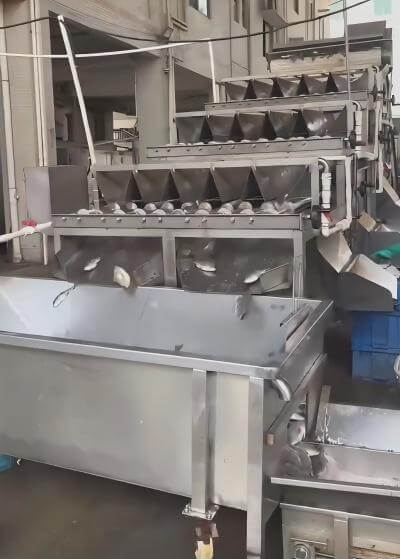
These are the four mainstream seafood grading machines. By now, you should have a clear idea about which one to pick.

If you only process a single type of product, it will be easy to find the perfect machine.

If you handle a wide range of seafood in different sizes, keep reading. I will share our proven solutions based on practical experience to give you useful references.
Most seafood processing plants handle more than just one type of product in daily operations.
Products vary greatly in size, market value and required output. A single sorting machine can hardly meet all production demands.

To balance output, grading accuracy, product appearance and operating costs, you need to create the best equipment combination based on your product types, sizes, profit margins and budget.

Drawing on years of on-site project experience, we have summed up four practical and reliable combined solutions suitable for most seafood processing facilities.

Mixed Fish Varieties with Large Production Volume

If your plant processes various fish such as hairtail, pomfret, grouper and sardines with a daily output of over 10 tons, we recommend pairing the Composite Layer Roller Grader with the Single/Dual Channel Weight Sorting Machine.

The Composite Layer Roller Grader efficiently sorts large quantities of small fish like sardines to maintain overall productivity.

The high-precision Single/Dual Channel Weight Sorting Machine accurately grades large and irregular-shaped fish. This combination balances output and accuracy, solving sorting difficulties for mixed fish products.

Single Type of Fish (Tilapia, Tuna, Pomfret, etc.)

If you only process one kind of fish, you can choose the right sorter according to fish size and product value.
For regular fish with medium market value, the Common Roller Grading Machine delivers the best cost performance. It runs steadily and requires little maintenance, perfect for mass production.

For large, high-value fish, go for the Dual-channel Weight Sorting Machine. Its precise dynamic weighing ensures consistent grading results.

If you mainly process small fish and need extremely high output, the Composite Layer Roller Grader is your top choice for stable large-batch sorting.

Shrimp of Various Sizes

When processing shrimp in a full range of sizes, your choice mainly depends on budget and quality standards.

If you have a tight budget and do not require ultra-high grading precision for bulk shrimp production, the Common Roller Grading Machine works well for basic size sorting. It features low investment and high capacity, ideal for large-volume sales.

If you process all sizes of shrimp and large ones bring extra profits, combine the Common Roller Grading Machine with the Dual-channel Weight Sorting Machine.

Use the roller grader for fast bulk sorting of standard shrimp, and the weight grader for precise grading of premium large shrimp, so as to raise their selling price and improve appearance.

For plants focusing on large, high-value shrimp, run multiple Rotating Trays Weight Graders side by side. This equipment handles products gently without damaging shrimp, and delivers even grading. It fully preserves the quality of premium shrimp and meets standards for high-end seafood production.

Mixed Seafood in Various Sizes

We also have proven solutions for mixed seafood processing. The Dual-channel Weight Sorting Machine offers great versatility when you process different medium and large-sized seafood, and delivers accurate grading for all kinds of large aquatic products.

If your products are mainly small but high-value seafood, the Rotating Trays Weight Grader stands out with its gentle sorting. It greatly reduces product damage and ensures good quality and economic returns.
Every seafood plant has unique production conditions. Feel free to consult professionals or learn from industry peers before making your final decision.

How to Balance Costs and Benefits?

Choosing between machine sorting and manual sorting can be tricky. A simple way to decide is to calculate your annual labor costs, then compare them with the equipment purchase price and yearly maintenance fees.
Labor costs include more than just monthly wages. You also need to cover staff management, accommodation and expenses caused by high worker turnover. What’s more, manual sorting is slow and often falls behind when orders pile up. Different workers judge standards differently, leading to inconsistent grading quality.

As for machines, you only need to pay a one-time purchase fee. The ongoing costs are just electricity and basic maintenance, which saves you money in the long run. Machines run much faster to handle large orders easily, and they follow unified standards to keep product quality steady.

Manual sorting works fine for you if you have low daily output and a limited budget. But when orders keep growing and your workers can no longer keep up, switching to machines will cut your long-term costs. Besides, machines are highly recommended for high-value seafood that demands strict appearance and grading standards. Take production volume, budget and quality requirements into account, and you will make the right choice easily.

Conclusion

These are the four main types of seafood grading machines available. Every seafood processing plant has its own unique working conditions.

If you are still unsure after reading this guide, you can turn to industry experts for project assessment and customized solutions.